Simplifying Bank Account Claims with a Legal Heir Certificate in India
Securing access to a deceased relative’s bank account in India requires precise steps and legal proof of heirship. Legal heir certificates serve as a crucial document, but processes can be daunting. This guide provides step-by-step assistance for obtaining a legal heir certificate for bank account claims, clarifies differences from succession certificates, and outlines what to expect if you are an NRI or face regional rules in places like West Bengal and Telangana. Whether you are dealing with a nomination dispute or complex real estate assets, you will find practical solutions with expert-backed clarity at every stage.
Understanding the Role of Legal Heir Certificates in Bank Account Claims
When a bank account holder passes away, banks need to establish the rightful person or persons who can access or claim the account’s funds. Financial institutions do not release funds simply on verbal requests or familial ties. They mandate documentary proof that outlines the claimant’s relationship with the deceased, which generally comes in the form of a legal heir certificate. This certificate has a central role, especially for cases not settled by nomination. It officially lists the legal heirs and is recognized by local authorities and courts.
- Banks may request other supporting documents, including death certificates and account details.
- Indian succession law (Succession act) recognizes legal heir certificates for immovable and movable assets, especially non-nominated accounts.
- Some states, such as Tamil Nadu (where the document is known as the Varisu certificate) or West Bengal, have their own forms and procedures.
Having this document minimizes the risk of disputes and shortens the time it takes to access funds. For NRIs and families with property across states, validity and local acceptance of legal heir certificates are vital for seamless claims.
Who Can Obtain a Legal Heir Certificate for a Bank Account?
The eligibility to apply for a legal heir certificate involves more than immediate family ties. It considers legal succession as per both statutory and customary law, mirroring rules recognized by the Indian courts and reflected in inheritance and succession documentation. Not everyone with close relations automatically qualifies. A nominee, listed by the deceased in their bank records, may be the initial contact, but the certificate is essential when:
- No nominee is designated, or the nominee is deceased.
- There are multiple potential heirs, including children, spouse, or parents.
- The nominee differs from the legal heirs, necessitating formal succession recognition.
- Claims involve assets other than bank funds, such as real estate or shares.
- NRIs, extended families, or minors are involved, triggering additional compliance checks.
Legal heirs recognized under succession law include spouse, children (including adopted), parents, and, in rare situations, siblings or grandchildren—each circumstance may require specific supporting documents.
Key Documents Required for Legal Heir Certificate Application
Submitting a complete and accurate set of documents is essential for smooth and timely processing. Most authorities now require these original records and self-attested photocopies to support your application.
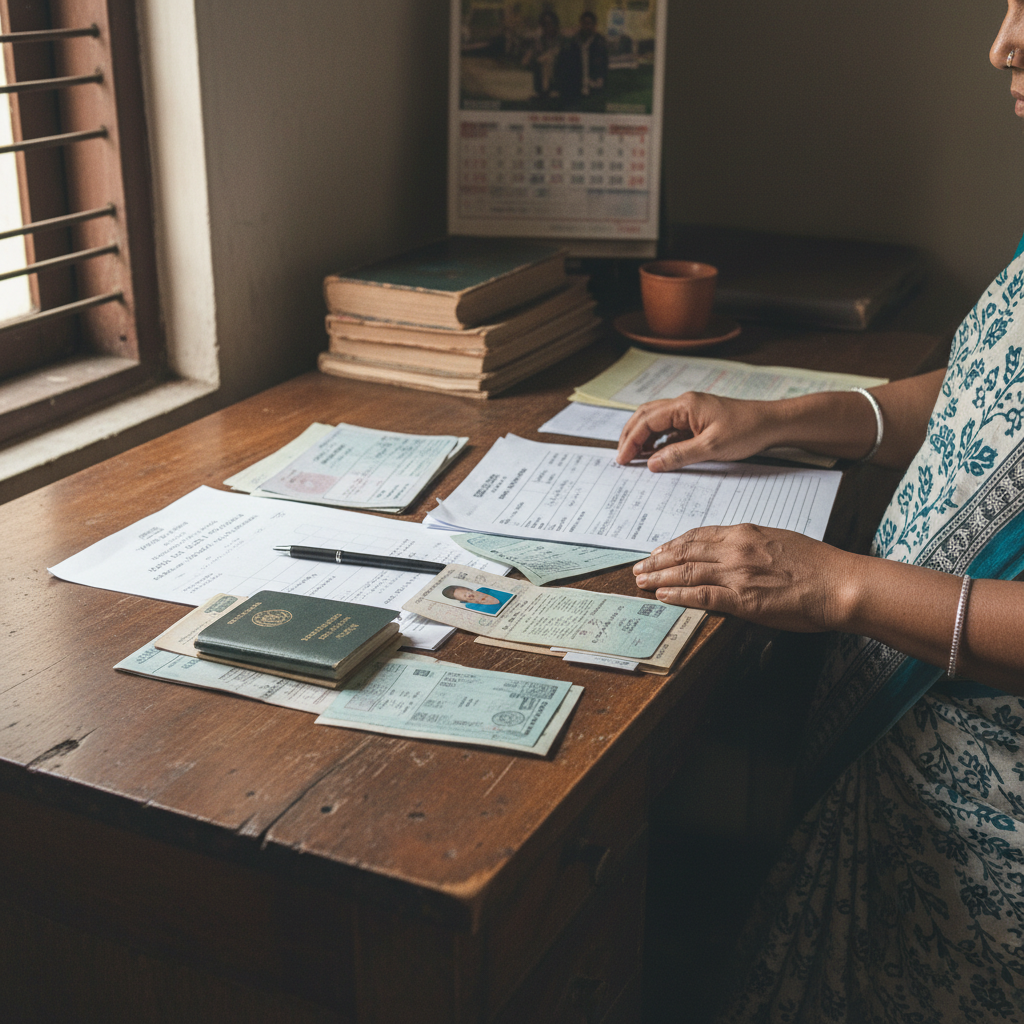
- Application form or written request in prescribed Letter format, as mandated by your jurisdiction
- Deceased person’s death certificate (original and copy)
- Address proof and identity proof of all legal heirs—Aadhaar, passport, or voter ID
- Bank passbook copy or account statement for the account in question
- Proof establishing relationship: birth certificates, marriage certificates, or government-issued documents
- Affidavit or self-declaration by claimant regarding legal heirs
- Passport-size photographs of the applicant(s) and deceased
- Any prior nominations, will, or succession documents (such as prior Varisu certificate or court-issued succession certificate)
- For NRIs: proof of overseas address and notarized identification documents, possible embassy attestation for cross-border claims
Additional documents may be requested by the local issuing authority (Tahsil, SDM office, or municipality), especially in states like West Bengal and Telangana with customized formats.
Application Procedure: How to Obtain a Legal Heir Certificate for Bank Account Purposes
The workflow for claiming a deceased person’s bank account using a legal heir certificate follows specific stages, ensuring every compliance point is covered. Applicants should keep in mind both procedural timelines and local rules:
- Visit the designated authority, such as local Tahsildar, Taluk office, or district magistrate’s office, depending on your city or region (for instance, in Chennai, a specific Varisu certificate application office)
- Request the application form or submit a clearly written application letter (in local language or English, per the office’s accepted Letter format)
- Attach all necessary supporting documents and fill out details as per the prescribed Application format
- Pay the official processing fee, keeping the receipt for reference
- Attend the required verification process, where local officers may visit the home, interview neighbors, or review family registers to confirm relationships
- Respond promptly to any requests for additional details, clarification, or missing documents
- Track your application’s status using the local government portal or in-person follow-up (certain states have digitized tracking for transparency)
- Collect the issued legal heir certificate in person or, if allowed, download it from the official portal after digital signature validation
With the legal heir certificate in hand, present it to the bank with the completed death claim form for further processing of the claim.
The Difference Between Legal Heir Certificate and Succession Certificate
Families often confuse legal heir certificates and succession certificates, yet their roles are distinct in compliance and scope. Understanding this difference is pivotal, as banks may request one or the other depending on circumstances:
- Legal heir certificate: Used for establishing the list of legal heirs, essential for bank account closure (savings/current), pension claims, and basic property transfers. It is generally issued by local revenue authorities and is not a court judgment.
- Succession certificate: Required for transferring movable assets such as shares, securities, or large funds when there are disputes or no valid nominated beneficiary. This certificate is obtained via a formal court procedure under the Succession act, involving public notice and possible legal objections.
- Legal heir certificates are typically faster to obtain, ideal for straightforward bank account claims, and are favored by revenue and municipal authorities. Succession certificates involve court fees, legal representation, and may take several months, but are legally binding across Indian territory.
If the bank’s compliance officer is uncertain or when asset ownership is contested, the need for a court-issued succession certificate becomes unavoidable. Consulting with property lawyers, such as those at PropResolve, ensures you avoid unnecessary delays and gather the right documentation from the outset.
Regional Differences: West Bengal, Tamil Nadu (Varisu), Telangana, and Beyond
While the underlying purpose of a legal heir certificate remains similar across India, procedural variations exist. The terminology, issuing authorities, and compliance headaches can shift dramatically from state to state:
- West Bengal: The application format, required affidavits, and court intervention differ from other states. Municipal authorities control the process, and property inheritance often includes additional steps.
- Tamil Nadu (Varisu certificate): The Varisu certificate serves as the official legal heir certificate, demanded by both public and private banks. There may be a preference for Tamil Letter format and additional rural-specific verification.
- Telangana: Regional offices sometimes require applicants to appear with local representatives, and affidavits occasionally need attestation by village elders.
- Other states may have digitized parts of the inheritance certificate issuance, while some remain strictly manual and depend on home visits by officers.
Importantly, compliance with regional requirements avoids time-consuming rejections. NRIs especially benefit from working with professionals who understand local nuances and can coordinate cross-state documentation.
Bank Nominee Versus Legal Heir: Priority and Procedure
One of the biggest points of confusion is the distinction between a nominee and a legal heir. A nominee is the person listed by the account holder at the time of account creation or update. This individual acts essentially as a custodian or caretaker, collecting proceeds on behalf of the legal heirs. Having a nominee does streamline initial claim processing, but it does not override succession rights under Indian law.
- If the nominee and legal heir are different, banks will require a legal heir certificate before disbursing the funds permanently.
- In cases where the nominee and legal heir are the same, the process is usually expedited.
- Conflicts are more likely in larger families, disputed nominations, or where the real estate portfolio or shares are involved, requiring careful adherence to legal requirements.
Understanding your rights as a nominee or legal heir saves time and helps prevent avoidable legal challenges, especially if tax or representative assessee obligations (like income tax filings) arise after the account holder’s demise.
Step-by-Step: Presenting the Legal Heir Certificate to the Bank
After receiving your legal heir certificate, moving forward with the bank account claim requires you to meticulously prepare and present documents as per compliance guidelines. Here is the recommended flow:
- Fill out the bank’s death claim form, which records essential data on the account holder and claimants. Carefully match these details with those on your legal heir certificate and other documentation to avoid discrepancies.
- Submit the legal heir certificate and death claim form to the branch manager or dedicated succession/legal desk, attaching self-attested ID proofs and a copy of the deceased’s death certificate.
- Include copies of the bank passbook or statement and, where applicable, copies of prior applications or letters submitted during initial communication with the bank.
- For accounts with significant assets or in dispute, banks may request additional verification, involving compliance, internal legal, or their court retainer for further clarification as per the Succession act.
- If multiple heirs are listed, provide a no-objection certificate (NOC) or joint application from all legal heirs to streamline claim settlement.
- Wait for the bank’s representative assessee to validate submissions, after which funds are released or transferred as per banking policy and regulatory guidelines.
- For NRIs or those unable to be present, a power of attorney (POA), duly registered and recognized by Indian registration authorities, may be submitted to empower a local nominee or lawyer to complete the process.
This stepwise approach, coupled with diligent verification by both bank and applicant, ensures reduced chances of delays or rejections due to oversight.
Common Issues and How to Avoid Claim Processing Delays
Delays can be frustrating and sometimes expensive, especially if inheritance tax or income tax filing seasons are near. Some of the main hurdles families encounter include incomplete documentation, usage of outdated application formats, legitimacy disputes, and jurisdictional confusion for those with interstate or overseas links. To mitigate these:
- Double-check that all forms and information match across the legal heir certificate, death claim form, and supporting IDs.
- Use the latest application format as prescribed by your authority, especially in states with annual updates.
- Anticipate bank compliance requirements and seek guidance from property and inheritance professionals if you are claiming high-value or complex assets, like shares or real estate.
- Utilize forensic document verification services for title chains or prior transactions cited in claims involving large deposits or linked real estate.
- If a nominee or legal heir is overseas, ensure POA and application letters are notarized and apostilled as required by Indian law.
Setting up a project manager or legal liaison, as offered by leading legal firms, provides real-time updates, reduces documentation gaps, and streamlines the end-to-end process.
Income Tax, Compliance, and the Role of Representative Assessee
Bank accounts or real estate left by a deceased individual sometimes attract scrutiny from tax authorities, especially if the account held substantial funds or earned income (as interest, for instance) after death but before claim settlement. The Income tax department requires a responsible party—often called the “representative assessee”—to file returns and settle liabilities for the estate. This role typically falls upon the first legal heir or joint applicant making the bank claim.
- Coordinate early with tax professionals if suspected liabilities exist, such as capital gains from real estate sales or undeclared interest income.
- Quote the legal heir certificate, succession certificate, or court affidavits within correspondences to minimize notices or audits.
- Respond quickly to any compliance queries or Section 142(1) notices initiated during claim or succession filing.
- Retain proof of transfer and NOC documentation for at least five years in case retrospective income tax assessments occur.
Legal complexity increases where multiple heirs, minors, or overseas inheritances exist, reinforcing the need for expert project management.
Special Considerations for NRIs and Cross-Border Families
For families with Non-Resident Indians (NRIs) or overseas citizens, obtaining a legal heir certificate for bank account claims involves additional diligence, document attestation, and compliance with both Indian and foreign regulations. Smoother outcomes are possible by adhering closely to these recommendations:
- Ensure all supporting documents are properly notarized and, where appropriate, apostilled or consular attested to meet Indian legal standards.
- Anticipate time zone and postal delays by opting for digital submission and regular tracking if facilities exist in your local jurisdiction.
- Consider appointing a POA in India to act on your behalf for both certificate application and representation with banks and courts.
- Check if local Indian rules require presence at the Tahsildar or court or if embassy-issued affidavits are accepted (varies by state and type of asset—bank funds, real estate, shares).
Professional legal and administrative support is highly recommended for intricate, multi-jurisdiction asset transfers.
Forensic Document Vetting and Real Estate Asset Claims
Claims involving real estate in addition to bank accounts require extra caution. Title issues, unregistered sales, or unclear legacy documentation (such as old Letter format or handwritten records) often delay or entangle claims. Utilizing forensic document verification and title-chain vetting—services offered by experienced property due diligence firms—provides the following benefits:
- Ensures submitted succession documentation aligns with on-record property title and stamp duty records
- Identifies gaps or discrepancies in previous transfer, partition, or will records
- Improves acceptance chances at banks, courts, and revenue offices, especially in high-value real estate inheritances
- Reduces legal risk and supports smooth mutation or transfer in city registry offices
Do not disregard veracity checks, especially when contested assets or a long gap between death and claim exists.
Compliance Tips: Maximizing Efficiency in Application and Claim
Effectively managing the legal heir certificate process for bank account claims involves equal measures of paperwork accuracy and proactive communication with authorities and financial institutions. Key compliance practices include:
- Regularly check for updates on official formats, biometric verification, or document checklists via local government portals
- Retain all interaction documentation—application forms, receipts, emails, or letters—until final settlement of both financial and property matters
- Anticipate additional compliance checks if the deceased owned significant real estate or had large unclaimed balances, such as demat shares or non-resident fixed deposits
- For enterprises, assign a representative assessee or compliance officer to manage succession filings, income tax returns, and regulatory notices
Staying informed and organized increases your chances of a swift, hassle-free inheritance experience, whether for personal, family, or business purposes.
Conclusion
Obtaining a legal heir certificate for bank account claims in India is a structured yet nuanced process. Start with the right documentation, recognize the difference between nomination and legal heir, and stay aware of regional requirements. Proactive compliance paired with expert legal assistance ensures both efficient claims and long-term peace of mind for heirs and successors. At every step, trusted support from professionals such as PropResolve brings clarity, confidence, and swift resolution, whether your claim involves routine accounts or complex assets across states and borders.
Need help with your legal documentation?
Talk to PropResolve. Verified Karnataka lawyers and full support for NRI and OCI families. We respond within one business day.