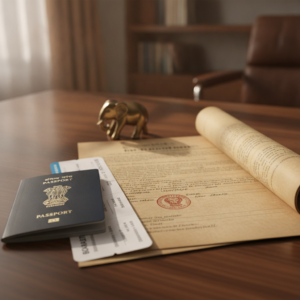
The Essential Facts About Family Member Certificates in India
In India, managing property and inheritance issues can become complex, especially after the loss of a family member. One document often required is the family member certificate, an official record that proves the surviving members of a deceased person’s family. If you are seeking end-to-end support for property formalities, PropResolve’s services offer expert guidance, from the application process to obtaining the certificate, including specialized assistance for NRIs and property documentation across cities such as Delhi, Telangana, and Karnataka.
Understanding the Family Member Certificate: Meaning and Importance
A family member certificate serves as official government recognition of the surviving family members after a person’s death. It is widely needed to establish rightful claims to benefits, assets, employment, or bank accounts held by the deceased. Unlike a legal heir certificate, which specifically focuses on those legally entitled to inherit, the family member certificate lists all surviving family, including those who may not necessarily have inheriting rights.
- It acts as crucial proof for surviving dependents in various administrations.
- Mandatory for claiming certain government benefits and insurance proceeds.
- Often required for updating property records or securing a deceased person’s job benefits.
- Accepted as an identity and relationship proof in many legal and official settings, including Karnataka, Telangana, and Delhi jurisdictions.
Given its official status, government agencies such as local revenue offices and ward sachivalayam are the authorities that process and issue this certificate through a standard legal procedure.
Key Differences Between Family Member and Legal Heir Certificates
There is frequent confusion between family member certificates and legal heir certificates, but they are not interchangeable. Understanding the specific roles and applications of both helps streamline the property or inheritance process.
- A family member certificate lists all surviving relatives, including those without inheritance rights, while a legal heir certificate focuses solely on legitimate claimants.
- Family member certificates are generally required for transfers of utilities, educational benefits, or pension claims in regions like Telangana and Karnataka.
- Legal heir certificates form the foundation in succession matters and property transfer on the basis of inheritance.
- Application processes, forms, and responsible authorities differ markedly; for instance, Meeseva and ward sachivalayam facilitate applications in Telangana, while local administration offices do so in Karnataka and Delhi.
For clear guidance on choosing the right document and understanding the implications, PropResolve’s experts provide tailored advice aligned with specific state requirements and document needs.
Who Can Apply and When Is the Certificate Needed?
Initiating the family member certificate process requires the involvement of a proper person—someone closely related to the deceased, typically a surviving spouse, adult child, or parent. The application is often required for a variety of legal and personal formalities soon after death.
- Surviving family needing to claim provident fund, insurance, or pension benefits.
- Family settling utility bill transfers or school admissions for children after a parent’s demise.
- Application to include all close surviving relations for official records, as commonly mandated across states like Karnataka and Telangana.
- Most states, including Delhi, require an Affidavit by the applicant to establish their relationship to the deceased.
This certificate helps in smooth facilitation of formalities by providing clear proof of family structure, especially during stressful times following a bereavement.
State-Wise Processes and Authorities Involved
The issuing authority and the exact process can vary from one region to another. Some prominent states and their systems are explained below to help applicants understand the path ahead.
- In Telangana, Meeseva centers process submissions—applicants must submit documentation and a correctly filled legal heir certificate application form.
- Karnataka residents approach the local revenue department or ward sachivalayam for document verification and issuance.
- Delhi processes applications through the sub-divisional magistrate or district collector, requiring comprehensive documents and an Affidavit.
- Processing time typically ranges from 15 to 30 days if all documents are in order.
Regardless of the state, starting with an accurate legal heir certificate application form, valid relationship documents, and full cooperation with authorities like the Meeseva or ward sachivalayam ensures a smoother experience.
Documents Required for a Family Member Certificate
Providing correct and complete documentation is crucial. Most states ask for a common set of proofs, though procedural variations do occur. Applicants should prepare the following:
- Death certificate of the deceased as mandatory evidence.
- Proof of relationship (like Aadhaar, ration card, or school certificates naming the applicant and deceased).
- Address and identity proofs of the applicant and all listed surviving members.
- An Affidavit in required format, as per local jurisdiction in places like Delhi, Telangana, and Karnataka.
- Legal heir certificate application form downloaded from designated government websites or collected in person at authorized centers like Meeseva.
Fulfilling the document checklist can prevent rejections or delays, especially when clarity for every surviving family member is required.
Step-by-Step Procedure to Apply
The application process involves several sequenced steps, each essential for successful issuance of a family member certificate:
- Collect necessary documents and the application form from the designated local office or online portal—such as Meeseva for Telangana or ward sachivalayam for Karnataka.
- Complete the legal heir certificate application form, ensuring accuracy in the listing of every surviving member.
- Submit the application along with identity, address, and relationship proofs. Attach an Affidavit detailing your relation to the deceased.
- Authorities review and may verify claims with neighbors and the local community, particularly in Delhi and Telangana cases.
- On approval, the certificate is issued—either in person or mailed to the applicant, typically within the promised timeline.
For seamless handling across multiple states or if you are an NRI, PropResolve’s managed case support ensures each protocol is met efficiently.
Role of Professional Assistance in Navigating the Process
Errors or missteps in form submission or affidavit preparation often cause rejection or delay. Deploying experienced legal support becomes vital for:
- Verifying that the applicant qualifies as a proper person for the process.
- Providing guidance on nuances between family member and legal heir certificates, preventing costly confusion.
- Assisting in Affidavit drafting as per state requirements, critical in Delhi, Karnataka, and Telangana procedures.
- Helping NRIs or families with limited access to local agencies to streamline every step, including forensic title vetting.
Consulting a firm like PropResolve not only shortens the processing time but guarantees compliance, minimizing stress at a difficult time.
Conclusion
Obtaining a family member certificate is an essential step after the death of a loved one in India. Whether in Telangana, Karnataka, or Delhi, knowing the difference from a legal heir certificate, understanding the authority’s role, and preparing the correct affidavit and documentation are vital. With tailored support for both resident and NRI clients, PropResolve stands ready to simplify every stage, ensuring transparent, reliable, and fully managed legal solutions for property and inheritance matters. Don’t let complex paperwork delay your peace of mind—seek expert assistance to protect family interests with confidence.
Need help with your legal documentation?
Talk to PropResolve. Verified Karnataka lawyers and full support for NRI and OCI families. We respond within one business day.