Understanding Family Member Certificate and Vamshavruksha: Purpose and Differences
Handling property, inheritance, and family legal formalities in India typically requires specific documentation, such as a family member certificate or Vamshavruksha. Many individuals, especially those managing issues across multiple cities or as NRIs, often seek reliable guidance. For comprehensive assistance from application to verification, verified legal support for property due diligence can simplify such processes and bring peace of mind to families seeking clarity on these important certificates.
What Is a Family Member Certificate?
The family member certificate is an official government document issued by local authorities in states like Telangana, Andhra Pradesh, and Karnataka. This certificate identifies surviving family members of a deceased person, primarily to establish their relationship for inheritance, employment benefits, or insurance claims. It is considered preliminary evidence of kinship by many institutions in India. Unlike the legal heir certificate, its legal standing and precise use may vary by jurisdiction, especially in Delhi and metropolitan areas.
How a Family Member Certificate Is Used
The certificate’s practical benefit is that it allows families to access government benefits, claim property succession rights, and apply for services such as pension transfer or gratuity. It acts as proof of relationship with the deceased, but does not always confer absolute legal heir status in the eyes of all authorities.
- Required for transfer of government benefits such as provident fund or pensions
- Needed to initiate insurance or employment claim processes following bereavement
- Supports account name changes and asset claims within government records
- Used in property mutation applications in places like Karnataka and Delhi
Each purpose has document requirements and may sometimes need a supporting affidavit tailored as per local rules.
Essential Documents Needed for Application
Applying for a family member certificate involves gathering a defined set of documents and submitting them to the proper jurisdictional authority. Typical requirements include:
- Certified copy of the death certificate of the individual
- Residential proof of surviving family members
- Identity proof such as Aadhaar or PAN of applicants
- Legal heir certificate application form, especially if the request is routed for property succession in states like Andhra Pradesh or Telangana
- Affidavit format as specified by the local registrar or revenue office
Submission may occur at the Taluk office, Mandal Revenue office, or Ward Sachivalayam, depending on the state. The process is streamlined for the proper person, defined as the eldest surviving kin or guardian for minors. Misrepresentation, intentional or not, can delay approval or legalise complications.
Understanding Vamshavruksha: The Genealogical Record
Distinct from the family member certificate, the Vamshavruksha is a genealogical, tree-shaped record often required in Karnataka and parts of Andhra Pradesh. This document lists extended family lines, allowing official traceability of ancestry and inheritance succession, particularly relevant to community or agricultural land disputes or when a judicial order references the entire bloodline.
- Chronologically lists ancestors and descendants of a family
- Used by authorities to verify claims over ancestral property or organizational succession
- Essential in disputes where kinship or succession eligibility extends beyond the nuclear family
- Serves as backup in court cases when an affidavit does not suffice as proof of family lineage
Its acceptance in Delhi or urban land matters may be limited, but it remains important in rural inheritance situations and local registry processes.
Family Member Certificate vs Vamshavruksha: Core Differences and Roles
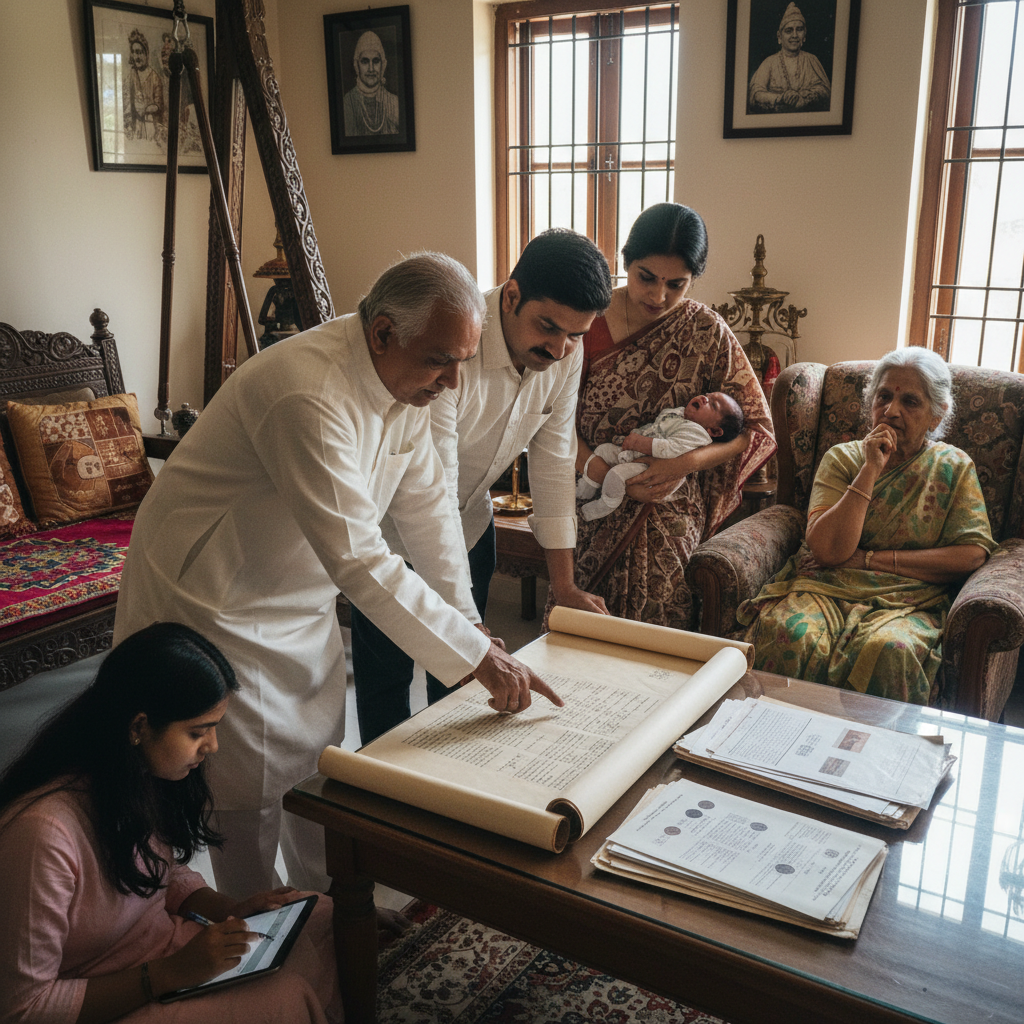
Although both documents relate to family identification, their functions, scope, and legal standing differ considerably. Understanding these differences is critical for making informed decisions during property transfer or inheritance cases.
- The family member certificate formalizes immediate familial ties after a death for routine claims.
- Vamshavruksha traces the broader lineage necessary for ancestral property verification or complex legal heir disputes.
- Legal processes in states like Karnataka or Andhra Pradesh may mandate the Vamshavruksha alongside an affidavit, whereas Telangana relies more on the simpler family member certificate for most government procedures.
- Institutions and banks sometimes accept only formal kinship certificates; courts or special tribunals may insist on detailed Vamshavruksha lineage documentation.
A proper person certificate may be needed as an interim proof when ambiguities in hierarchy or claims arise.
Application Process: Step-by-Step Guidance
The path to obtaining these certificates is generally straightforward with the right approach and supporting documentation:
- Obtain and fill out the legal heir certificate application form from the relevant district or online portal (Meeseva in Telangana, Nadakacheri in Karnataka, local SDM offices in Delhi).
- Gather mandatory documents – death proof, identity and residence confirmation, and an affidavit in the prescribed format.
- Affidavit and application are verified by the local revenue officer, who may conduct field inquiry or neighbor interviews.
- Once approved, the final certificate is issued listing surviving members and their relationship to the deceased.
- In cases requiring Vamshavruksha, a genealogical tree, sometimes notarized, must be appended and verified before legal acceptance.
Timelines vary: rural office processing may be slower, while metropolitan areas like Delhi can be more rigorous, particularly where property or large assets are involved.
Common Legal Considerations and Potential Hurdles
The process may become complicated due to variations in norms across states like Karnataka, Delhi, or Andhra Pradesh. Some typical challenges include:
- Conflicting claims or objections from other heirs
- Non-availability or outdated records, especially relevant to Vamshavruksha
- Incorrect details or omission of members in the affidavit or application form
- Procedural changes in submission requirements by local authorities or Ward Sachivalayam
Expert legal vetting is often required to overcome objections or to validate proper person claims, particularly where the succession of assets is under dispute. Reliable property documentation and due diligence, as provided by platforms like PropResolve’s property documentation services, can significantly reduce legal risks.
Expert Insight: Forensic Checking and Project Management
Increasingly, families and NRIs prefer engaging legal services that provide end-to-end project management, document vetting, and guidance for critical property or inheritance matters. Platforms offering PAN-India coverage support, such as succession certificate assistance, ensure compliance with Bar Council, RERA, and local administrative guidelines. This approach is especially vital for those with property spread across state lines, where each office—from the Meeseva centers in Telangana to Delhi’s SDM—has unique paperwork and process quirks.
In summary, proactive legal support, forensic affidavit checks, and streamlined document gathering are crucial to promptly obtain the correct certificate and smoothly complete inheritance or transfer proceedings.
Conclusion
Understanding what a family member certificate and Vamshavruksha represent can make or break the outcome of inheritance and property transfers in India. While the family member certificate aids routine claims and gives immediate recognition of surviving relatives, the Vamshavruksha unlocks more complex lineage verification when ancestral assets are in focus. Paying close attention to proper documentation, adhering to local authority requirements, and consulting with legal experts on affidavit format or the selection of a proper person can speed up processes and reduce future disputes. For guidance tailored to urban, rural, or NRI circumstances, PropResolve offers end-to-end legal and property services to simplify, verify, and secure your family’s essential rights.
Need help with your legal documentation?
Talk to PropResolve. Verified Karnataka lawyers and full support for NRI and OCI families. We respond within one business day.