NRI in Dubai with Property in India: Complete Guide to Wills, Power of Attorney and Property Management (2026)
If you are an NRI in Dubai with property in India, five questions tend to arrive together: how do I make a will that works in India, can my UAE will cover the flat, how do I give someone power of attorney from here, how do I rent or sell without flying home, and what happens to the property if something happens to me. This guide answers each in plain language and points you to the detailed PropResolve page for the next step. Most of it can be done from the UAE, with a trusted person in India doing the in-person work.
Updated for the Income-tax Act, 2025 (in force from 1 April 2026)
Last reviewed: October 2026 · Reviewed by the Propresolve legal team
Key takeaways
- Will: make a separate Indian will for Indian assets. Two witnesses, signed in Dubai, no travel, registration optional.
- UAE or DIFC will: useful for UAE assets, but Indian institutions usually want a foreign will proved in an Indian court, and a careless revocation clause can undo your Indian will.
- Power of attorney: sign before a consular officer, or use a UAE notary plus UAE foreign ministry and Indian mission attestation. The UAE is not an apostille country.
- Rent: into an NRO account, never NRE. The tenant deducts tax first, so agree the rate in writing.
- Selling: the buyer deducts tax on the sale under Section 393(2) of the Income-tax Act 2025 unless you hold a lower deduction certificate (Form 128). Remittance abroad is capped at USD 1 million per financial year from an NRO account.
- Inheritance: probate has been optional everywhere since December 2025. A nominee is not the owner. Without a will, your family needs heirship papers.
- Exit routes: a power of attorney can be cancelled, and a tenant who will not leave is handled through notice and the courts, never force.
What this guide covers
- Making an Indian will from Dubai
- Is a DIFC or Dubai will valid in India?
- Power of attorney from Dubai
- Managing and renting your property from Dubai
- Selling from Dubai: tax, certificates and repatriation
- Inheritance: probate, heirship and nominees
- Cancelling a power of attorney
- When a tenant will not vacate
- Kerala, Mumbai and Mangaluru: where the property sits matters
- Example: a Dubai family with a rented flat and a parent’s house
- Checklist for Dubai-based owners
- Frequently asked questions
Making an Indian will from Dubai
An NRI living in Dubai can make a valid will for property in India without setting foot in the country. What matters is that the document meets Indian law, not where you sign it. Our page on an Indian will for NRIs in the UAE covers the drafting service in detail. This section explains the rules you should know first.
What makes an Indian will valid?
Under the Indian Succession Act, 1925, a will must be in writing, made by an adult of sound mind, and signed by the person making it. Two witnesses must each see you sign (or see someone sign on your direction) and then sign in your presence. Both witnesses can be in Dubai. They should be independent adults. A witness who is also a beneficiary can lose the gift made to them, so use colleagues or friends who gain nothing under the will.
There is no stamp duty on a will, and registration with an Indian sub-registrar is optional. Many families still prefer to register when they next visit India, because a registered will is harder to challenge and easier to prove. If you cannot travel, an unregistered will signed and witnessed correctly remains valid.
What should an NRI will contain?
- A clear list of Indian assets: flats, plots, bank and NRO balances, shares, mutual funds and insurance, described closely enough to be identified.
- Beneficiaries by name and relationship, with a fallback if one of them dies before you.
- An executor in India, plus an alternate. Pick someone who can attend offices and who your family trusts. An executor abroad is possible but slows every step.
- A residuary clause so that anything you forgot still passes under the will.
- A territorial clause that says the will covers only your assets in India and that any UAE or DIFC will continues for assets there.
- Guardian wishes for minor children, if relevant.
Mirror wills for couples and the position for Muslim NRIs
Couples often make mirror wills: each leaves assets to the other, then to the children, with matching fallback provisions. The danger is a mismatch, for example a different executor or contradictory handling if both die together. Draft them together and check them against each other.
For Muslim NRIs, inheritance is generally governed by personal law, and a will can usually dispose of only about one-third of the estate without the consent of the other heirs. A will is still valuable, but the drafting must work within that limit. Take advice before assuming your wishes can be written freely.
Where to keep it and when to update it
Store the original somewhere your executor can reach: a bank locker in India, with a trusted relative, or with your advocate. Tell the executor where it is. Keep a scanned copy with your papers in Dubai. Review the will after a marriage, birth, death, divorce or the purchase or sale of property. A will that names a flat you sold years ago creates avoidable confusion.
If you want the detail on registration and format, read our blog on NRI will drafting and the service page for will drafting and registration for NRIs.
Not sure whether your existing will works in India? Send us the will and a list of Indian assets and we will tell you what to change. Book a 20-minute assessment or message us on WhatsApp.
Is a DIFC or Dubai will valid in India?
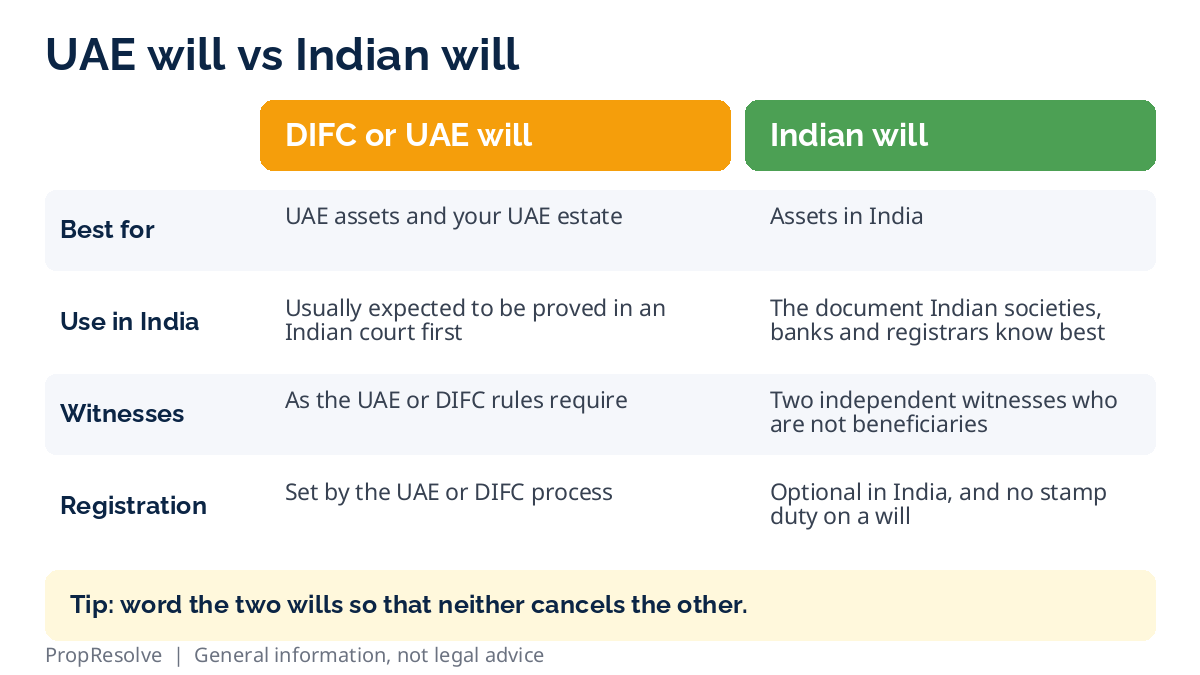
A will made in Dubai or registered at the DIFC is a genuine legal document, and it is the right tool for your UAE assets. For Indian property, the position is more careful. In India, a will usually has to be proved in court before institutions act on it, and for a foreign will banks, housing societies and land offices commonly ask for that step. We cover the detail in a separate article on is a DIFC will valid in India.
Why a UAE will may not be enough for Indian assets
Indian registrars and societies are used to Indian wills and to Indian legal vocabulary. A foreign will may use unfamiliar terms, a different witnessing method and a different idea of who administers an estate. The authority holding the Indian asset will often want the will tested before an Indian court, usually through probate or letters of administration, before it releases anything. That adds months and requires your family to appoint an advocate and attend hearings or sign affidavits.
The revocation clause trap
Many wills begin with a line cancelling all earlier wills. If your UAE will says that without limit, a later reader can argue that it also cancelled the Indian will you made earlier, or the other way round. The result can be two wills fighting for the same assets. The fix is simple but must be deliberate: each will should state which country it covers and say that the other will remains in force.
The two-will approach
| Question | UAE or DIFC will | Indian will |
|---|---|---|
| Assets covered | UAE assets | Indian assets |
| Who reads it | UAE courts and registries | Indian banks, societies, registrars and courts |
| Executor | Someone who can act in the UAE | Someone who can act in India |
| Where witnessed | As UAE or DIFC rules require | Anywhere, under the Indian Succession Act |
| Risk | Unlimited revocation clause | Unlimited revocation clause |
If you already hold a DIFC will, do not tear it up. Ask your advocate to review it alongside a new Indian will so the two documents cooperate. If your family is already dealing with a foreign will after a death, our note on probate for NRIs explains the Indian court route: probate of a will in India for NRIs.
Power of attorney from Dubai
A power of attorney lets someone in India act for you on your property while you stay in Dubai. It is the single most useful document for a long-distance owner, and the one most often done badly. Our page on power of attorney for NRIs in the UAE and the wider NRI power of attorney service explain how we handle it. Here is the framework.
Specific or general power of attorney?
A general power of attorney covers a broad range of dealings: paying property tax, collecting rent, handling utilities and appearing before offices. A specific power of attorney is limited to one task, such as selling a named flat. Buyers, their banks and sub-registrars trust specific documents more. For sale, a specific power that names the property, the survey or flat details, the right to sign and present the sale deed for registration, and the right to receive the sale amount, is safer than a broad document.
Remember what a power of attorney is. It is an authority to act for you, not a transfer of ownership. The Supreme Court has made clear that it does not by itself pass title in the property. Ownership changes only through a registered sale deed or another valid transfer.
Choosing the holder
Choose someone you trust, who lives in or near the property city and is comfortable visiting government offices. Consider naming an alternate in case the first holder is unavailable. Spell out limits: whether the holder may sell, at what minimum consideration, whether they may sell to themselves or close relatives, and whether they must report to you before signing. Add an end date or a task-based end, so the authority does not stay open indefinitely.
The two ways to sign in the UAE
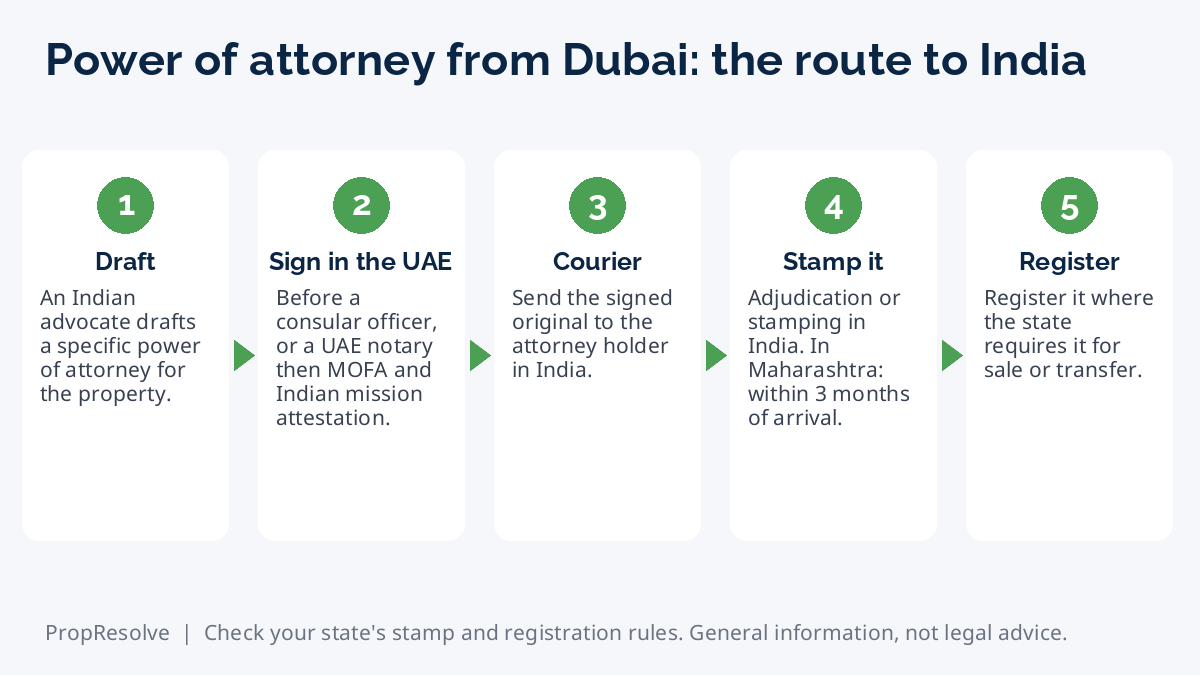
The UAE is not a member of the Hague Apostille Convention, so an apostille stamp is not the route for papers signed here (you can check the member list on the Hague Conference status table). Instead, a power of attorney from the UAE usually follows one of two routes.
| Route 1: consular officer | Route 2: UAE notary plus attestation | |
|---|---|---|
| How it works | You sign in person before a consular officer at the Consulate General of India, Dubai (or the Embassy in Abu Dhabi) | You sign before a notary in the UAE, then the document is attested by the UAE foreign ministry (MOFA) and then by the Indian mission |
| What you usually bring | The original document and a duplicate, your original passport with photocopies of the first pages and the residence visa page, and a recent photograph | Notary requirements, then whatever each attesting office asks for at the time |
| Personal presence | Required, with your original passport | Required before the notary |
| Steps | Fewer | More, spread over several offices |
| Best for | Most owners, because it has the fewest steps | Cases where a consular appointment is hard to get, or the document sits with other UAE-issued papers |
The Indian Embassy in Abu Dhabi publishes its attestation guidelines on its attestation services page, and the consulate has its own site at cgidubai.gov.in. Appointment systems, outsourced counters and document lists change. In particular, the centre that handles passport and visa services is not necessarily the one that takes power of attorney or affidavit attestations. Check the consulate website or call before you travel to the counter, and confirm with the mission if you plan to use a courier or an agent.
After you sign: stamping and registration in India
Courier the signed original to your holder in India. It then has to be made usable under the law of the state where the property sits. A document signed abroad is generally stamped on arrival, and the rule varies state to state. In Maharashtra, the stamping window is three months from first receipt in the state, under Section 18 of the Maharashtra Stamp Act. For other states, do not assume the same period: the state rule varies, so ask the registration office or your advocate before the document is couriered.
Many states also require a power of attorney that authorises sale or transfer of immovable property to be registered. A related point from the Registration Act, 1908: a document executed outside India can generally be presented for registration within four months of reaching India, at the registering officer’s discretion. Do not leave the document sitting in a drawer after it lands.
If your holder will later use it for mutation or for heirs abroad, see our guides on format and registration of a power of attorney for mutation and what a power of attorney for overseas legal heirs should include.
Managing and renting your property from Dubai
Owning a property in India while living in Dubai means two jobs: keeping the property safe and keeping its paperwork current. Most NRIs handle both through a holder under a general power of attorney, or through a caretaker or manager who reports to them. The legal points below matter more than the logistics.
Keeping the property in order
- Pay the recurring dues on time: property tax to the local body, society maintenance, electricity, water and any gas connection. Unpaid dues attach to the property and cause trouble at sale.
- Keep the title papers safe: the sale deed, society share certificate, tax receipts and mutation records. Store scans in the UAE as well as originals in India.
- Inspect regularly: a vacant flat or plot attracts leaks, damage and sometimes encroachment. Ask your holder or caretaker for dated photographs.
- Insure where you can: a buildings policy at least for a house, and contents cover if the property is furnished.
- File your Indian tax return: rent and any gain from Indian property are Indian income, and having no personal income tax in the UAE does not remove the Indian filing.
Renting out: the NRO rule
Rent from an Indian property is Indian income. It belongs in your NRO (non-resident ordinary) account, not your NRE account. An NRE account is meant for money you bring in from abroad, and rent that arises in India does not qualify. Ask your tenant to pay into the NRO account and keep rent receipts. From the NRO account you can later send money abroad within the RBI limit, which we cover in the selling section.
Tenant TDS on rent
When a tenant pays rent to a non-resident landlord, the tenant is generally required to deduct tax before paying. From 1 April 2026, the relevant provision sits in Section 393 of the Income-tax Act 2025, replacing the older Section 195 and related sections. The rate, and any surcharge or cess that applies, should be confirmed with a chartered accountant at the time you sign the agreement, and because the rules have just changed it is wise to recheck it each year. The practical steps are:
- Give the tenant your PAN. Without it the deduction can be higher.
- Put the TDS arrangement in the rent agreement: who deducts, who pays the tax and who files the statement.
- Ask the tenant to share the tax certificate each period, and match it against your return.
- If the tenant is a company or an office, expect them to follow the rule strictly. An individual tenant may need guidance.
- Where the deduction looks too high for your actual tax position, ask your adviser whether a lower deduction certificate can be applied for.
Writing a rent agreement that protects you from afar
A good agreement covers the term, the rent and escalation, the refundable deposit, who pays which bills, the notice period for ending the tenancy, and the lock-in. Many Indian cities expect tenant verification with local authorities, and a lease longer than a year needs registration under the Registration Act, which is why many owners use a shorter arrangement such as an 11-month agreement. Ask your advocate which structure suits your state. A clear agreement signed through your holder saves you from most later disputes. If a dispute does arise, see the section on tenants who will not leave.
When to use a manager instead
A relative is often the first choice, but relatives tire, move cities or fall out. A professional property manager works to a routine: rent follow-up, inspections and repairs, and reports on a schedule. Whoever you choose, keep the legal authority narrow. A manager who collects rent does not need the power to sell.
Selling from Dubai: tax, certificates and repatriation
Yes, you can sell without travelling. The sale deed is signed and registered in India by your holder under a specific power of attorney, while the tax and remittance steps run alongside. If you want the end-to-end service view, see our page on how to sell your property in India from Dubai. The sequence is below.
- Prepare the title: confirm ownership, clear dues, and settle any pending mutation or society transfer.
- Sign a specific power of attorney through the consulate or notary route described earlier, and complete the state formalities in India.
- Decide the tax approach: let the buyer deduct at the standard non-resident rate, or apply for a lower or nil deduction certificate first.
- Register the sale deed before the sub-registrar, with your holder signing and the buyer paying.
- Receive the money into your NRO account, keep the deduction certificate and file your return.
- Remit abroad, with the remittance forms and your bank’s checks.
TDS when an NRI sells
When a non-resident sells property, the buyer must deduct tax at source from the payment. This is Section 393(2) of the Income-tax Act 2025 (earlier Section 195). The deduction is typically applied to the whole sale consideration, not just the gain, which is why the buyer can end up withholding far more than your real tax liability. The buyer needs a tax deduction number (TAN), deposits the tax and gives you a certificate for it. Our blogs on TDS on an NRI selling property in India and on the TDS on sale of inherited property by an NRI walk through the mechanics.
The lower deduction certificate
If your actual capital gain is small, or there is a loss, you can ask the tax department for a certificate allowing the buyer to deduct at a lower rate or nil. Under the Income-tax Act 2025 the application is Form 128 (earlier Form 13), filed online on the income-tax system before the sale proceeds. The department will look at your likely gain, your past returns and your purchase records. Apply early: the certificate must be in hand before the buyer pays, and an application after completion is too late for the buyer to use it. The processing time varies, so build a few weeks into your plan.
The official Income Tax Department portal is where forms, rules and notices are published. Check it for the current form details, because the 2025 Act brought a new numbering scheme.
Capital gains and reinvestment
Tax on the gain depends on how long you held the property and what you paid. Holding period decides whether the gain is short-term or long-term, and the rates and indexation or reinvestment options depend on the law in force on the date of sale. Reinvestment exemptions exist subject to conditions. For an NRI, those conditions need care. Ask a chartered accountant to model the gain before you accept an offer, not after.
Repatriation to the UAE
Sale proceeds first land in your NRO account. From there, the RBI Master Direction on remittance of assets allows an NRI to remit up to USD 1 million per financial year out of NRO balances, including sale proceeds, subject to documentary evidence and the bank’s satisfaction. You can read the direction on the RBI website. Banks usually ask for the sale deed, proof of tax paid, the deduction certificate, a declaration and the remittance forms. From 1 April 2026 the 15CA and 15CB forms have become Forms 145 and 146 under the new Act.
Rules differ for property inherited and property bought, and different time conditions may apply to older rules. See our blogs on sending sale proceeds to the UAE and the FEMA rules for NRIs selling inherited property.
Planning a sale from Dubai? We map the power of attorney, tax certificate and remittance forms before you list the property. Book a 20-minute assessment or message us on WhatsApp.
Inheritance: probate, heirship and nominees
India has no inheritance tax, so the question after a death is not duty but proof: who is entitled, and what do the bank, society or registrar want to see? Our pages on NRI property inheritance in India and NRI property transfer cover the services. This section gives you the map.
Is probate still mandatory?
No. The Repealing and Amending Act, 2025, which received assent on 20 December 2025, removed Section 213 of the Indian Succession Act. That section had required probate for wills of Hindus, Buddhists, Sikhs and Jains tied to the old presidency towns of Bombay, Calcutta and Madras. Probate is now optional everywhere, and Delhi and Pune were never covered by the old rule. In practice, a housing society, bank or buyer may still ask for it, particularly for a high-value flat or where heirs disagree.
Our detailed pieces on probate in Mumbai and on why probate is no longer mandatory in Mumbai explain what to do instead, and when probate remains the safer choice.
Heirship papers when there is no will
If the owner died without a will, the family has to prove who the heirs are. The document is called different things in different states: legal heir certificate, family member certificate, surviving member certificate, heirship certificate or similar. It is issued by the authority that handles it for your purpose, which may be a revenue office or a civil court depending on the use, so confirm before filing. It is evidence of who the heirs are, not a court order of title, and it does not by itself transfer the property. See NRI legal heir certificate for the service.
Succession certificate, letters of administration and probate
| Document | Issued by | Typically used for |
|---|---|---|
| Legal heir or heirship certificate | Revenue authority or court, depending on state and purpose | Identifying heirs; mutation; some bank and insurance claims |
| Succession certificate | District Court, under Part X of the Indian Succession Act, 1925 | Debts and securities: bank balances, shares, insurance |
| Letters of administration | Court | Estates without a will, or where no executor is available |
| Probate | Court | Proving a will; optional but sometimes asked for |
The right paper depends on the asset and on who is asking for it. A bank and a housing society may ask for different things for the same death. For a succession certificate, see NRI succession certificate. When heirs abroad agree to give up their share to one sibling, the usual instrument is a registered release deed. Stamp treatment depends on the state, so confirm on the state portal. The Mumbai-focused NRI release deed page covers that route in one city.
Nominee versus legal heir
This is the most common misunderstanding we meet. A nominee on a bank account, demat account, insurance policy or society record is someone the institution can safely pay or transfer to. The nominee holds the asset for all the legal heirs and is not the sole owner. Who actually owns it depends on the will, or on the law of succession if there is no will. Our article on nominee vs legal heir explains how to avoid a family dispute over this.
Agricultural land and other special cases
Under FEMA, an NRI or OCI can inherit agricultural land but cannot buy it. A later sale is generally only to a resident Indian citizen. When the property is eventually sold, capital gains tax is calculated using the previous owner’s purchase value and holding period. If heirs live in different countries, a power of attorney for overseas heirs lets one person in India act for the rest.
Cancelling a power of attorney
Trust changes. A holder moves abroad, a relationship breaks down, or the task is complete. As the person who gave the power, you can generally end it, but you have to do it properly, or others may keep relying on it.
How to revoke it
- Check the document: some powers are expressed to be irrevocable or tied to an interest in the property. Those cannot be cancelled casually, so take advice first.
- Sign a deed of revocation: a short written document that identifies the original power, names the holder and says the authority ends. If you are in Dubai, sign it through the same consular or notary route.
- Register the revocation where the original was registered: if the power was registered with a sub-registrar, revoking it in the same office is the cleaner course. Confirm the state rule.
- Send written notice to the holder by courier and e-mail, and ask for the original and every certified copy to be returned.
- Tell everyone who dealt with the holder: your bank, the society, the sub-registrar, brokers, tenants and utilities. A power ends between you and the holder when you revoke it, but third parties who have not heard can still act on it in good faith.
- Consider a public notice in a local newspaper where the document was widely used.
A power of attorney also ends on the death of the person who gave it. After a death, the family needs its own authority: heirs, executor or a new power from the surviving heirs. If you want to give a fresh power to someone else, do the new document and the revocation together so there is no gap.
When a tenant will not vacate
A tenant who stops paying or refuses to leave is the most stressful problem for an owner in Dubai. This is an overview, not a litigation guide, because the law differs by state and by the type of tenancy. The first rule is simple: do not use force, change the locks or cut utilities. That can expose you to complaints and weaken your case.
What to do first
- Read the agreement: the term, notice period, lock-in, deposit clause and who may terminate. If the tenancy was for a fixed term that has ended, say so in the notice.
- Gather records: rent receipts, bank statements, messages and photographs of the property.
- Send a written notice through your holder or advocate, stating the grounds and a reasonable time to leave.
- Try a negotiated exit: an agreed move-out date, with the deposit returned after inspection, is often quicker than any court.
If the notice is ignored
The next step is a civil court or a rent authority, depending on the state and whether a rent control law or a newer tenancy law applies. Termination of a monthly tenancy usually needs proper written notice under the Transfer of Property Act or the state law. A court case can take several months or longer. Your holder, or an advocate with authority, can usually run it on your behalf, though a court may sometimes ask you to give evidence or attend by video. Be realistic about timing, and be wary of anyone who promises a guaranteed outcome.
Preventing the problem
Use a clear agreement, verify the tenant’s identity as your city requires, take a refundable deposit, record the condition of the flat in an inventory, and keep rent flowing into your NRO account so you notice any lapse early. A rent default that you address quickly is far easier to handle than one that sits for a year.
Kerala, Mumbai and Mangaluru: where the property sits matters
Indian property law is a mix of central statutes and state rules. For stamp duty, registration practice, local records and the office that handles each step, the state and city of the property decide the detail. Many Gulf-based families hold property in Kerala, in Mumbai and around Mangaluru and Udupi, so a few general pointers are useful.
- Kerala: the property is governed by Kerala stamp and registration practice. Confirm the stamping and registration requirement for a power of attorney, the process for updating local land and tax records, and the name each document goes by locally with the sub-registrar office and the local body.
- Mumbai: housing societies play a large role, with transfers, nominations and no-objection letters from heirs. Maharashtra has its own stamp rule for powers of attorney signed abroad. See our hub on succession, will and power of attorney services in Mumbai for the local detail.
- Mangaluru and Udupi: the property sits in Karnataka, so Karnataka stamp and registration rules apply, and records are maintained locally. A local advocate can confirm what the office will want to see.
Whatever the city, ask the local office what it requires before you sign anything abroad, keep copies of every document, and expect local-language records to need translation. A power of attorney that is perfect in Dubai but wrong for the state wastes weeks.
Example: a Dubai family with a rented flat and a parent’s house
Consider a couple in Dubai who own a flat they rent out and who have just lost a parent who left a house with no will. The flat rent is landing in an NRE account, which is wrong. They hold a DIFC will with a broad revocation clause, no Indian will, and no one in India with authority to act.
The sensible order of work looks like this. First, move rent into an NRO account and put the tenant’s tax deduction into writing. Second, sign a power of attorney through the consular route in favour of a trusted sibling in India, with stamping and registration done for the right state. Third, ask an advocate to review the DIFC will and add a territorial clause, and make an Indian will for the flat and the inherited house. Fourth, begin the heirship papers for the parent’s house, with each heir abroad signing a no-objection or release as needed. None of this requires a trip, but it does need patience: expect several weeks for each stage, and several months if a court is involved.
Checklist for Dubai-based owners
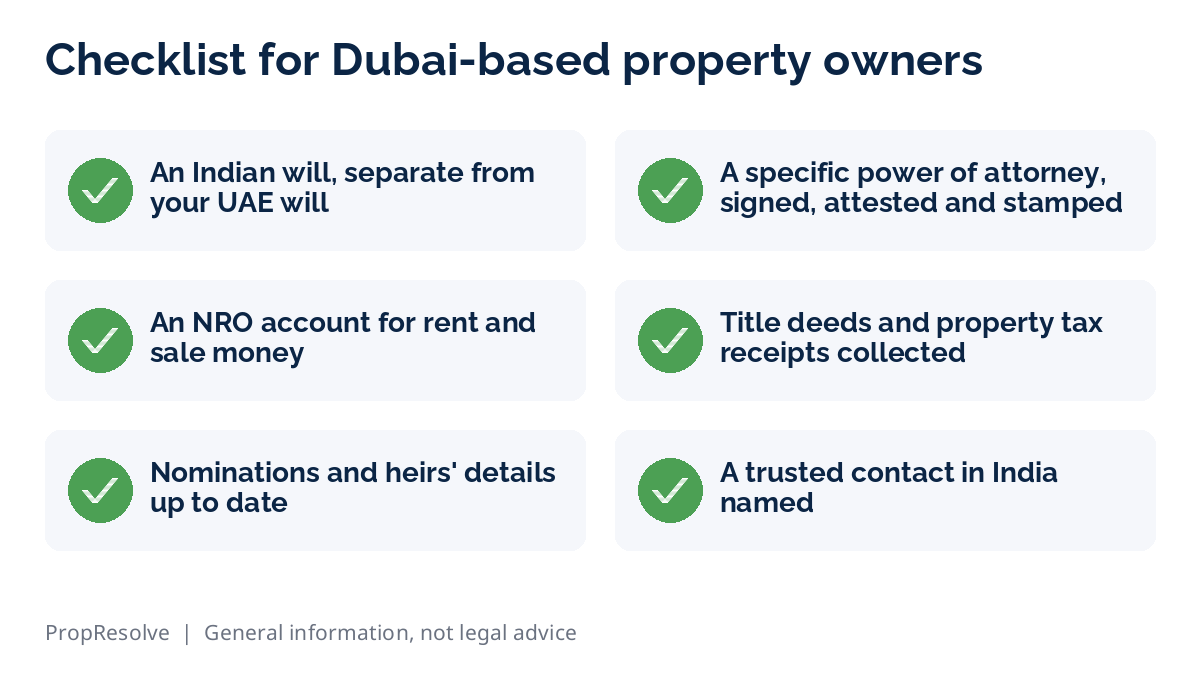
- Make an Indian will, with two independent witnesses and a territorial clause.
- Review any UAE or DIFC will so its revocation clause cannot undo the Indian will.
- Sign a specific or general power of attorney through the consular or notary and attestation route.
- Check the stamping and registration rule for the state of the property before couriering.
- Open and use an NRO account for rent and sale proceeds.
- Record the tenant’s tax deduction in the agreement and collect the certificate.
- Update nominations on bank, demat, insurance and society records.
- Keep title papers, tax receipts and scans in both countries.
- Tell your executor and your holder where the originals are.
- Review everything after a purchase, sale, marriage, birth or death.
| Common mistake | What goes wrong | Fix |
|---|---|---|
| Rent paid into NRE | Account rules breached, tax confusion | Use NRO and move the tenant’s payment |
| One will for both countries | Clashing revocation clauses | Two territorial wills |
| General power for a sale | Buyer’s bank refuses it | Specific power naming the property |
| Assuming the nominee owns the asset | Dispute between heirs | Make a will |
| No lower deduction certificate | Large amount held back by the buyer | Apply before the sale |
| Revoking a power quietly | Third parties still rely on it | Revocation deed plus notices |
Frequently Asked Questions
Can an NRI in Dubai make a will for property in India?
Yes. A Dubai-based NRI can make a valid Indian will without travelling to India. It must be in writing, signed by you and attested by two witnesses who each see you sign. The witnesses can be in Dubai. Registration in India is optional, and a will does not attract stamp duty.
Is a Dubai or DIFC will valid for property in India?
A Dubai or DIFC will can be relied on in India, but banks, societies and land offices usually expect a foreign will to be proved before an Indian court first. Most NRIs in the UAE therefore keep a separate Indian will for Indian assets, with each will limited to its own country.
How do I give power of attorney from Dubai to sell property in India?
Have an Indian advocate draft a specific power of attorney, then sign it before a consular officer at the Consulate General of India, Dubai, or before a UAE notary followed by UAE foreign ministry and Indian mission attestation. Courier the original to your holder, who then completes the stamping and registration steps your state requires.
Does a power of attorney signed in Dubai need to be registered in India?
It must be stamped as the law of the property’s state requires, and many states also require registration when it authorises sale or transfer of immovable property. Time limits differ by state. In Maharashtra the stamping window is three months from first receipt. Confirm the rule for your state before couriering.
Can I sell my property in India without travelling from Dubai?
Yes. A holder in India can sign and register the sale deed for you under a specific power of attorney that names the property and the power to sell. The buyer must deduct tax on the sale unless you hold a lower or nil deduction certificate, and your bank will check the remittance papers.
Can I collect rent from my Indian property in an NRE account?
No. Rent from Indian property is Indian income and belongs in an NRO account, not an NRE account. Your tenant must deduct tax before paying you, so agree the deduction in writing. You can later send money abroad from the NRO account within the RBI limit.
Is probate still mandatory in Mumbai?
No. The Repealing and Amending Act, 2025 removed section 213 of the Indian Succession Act in December 2025, so probate is optional across India, including Mumbai, Chennai and Kolkata. A housing society, bank or buyer may still ask for it, especially for high-value property or where heirs disagree.
Is a nominee the owner of the property?
No. A nominee is a person the institution can safely hand the asset to, and the nominee holds it for all the legal heirs. Ownership follows the will, or the law of succession if there is no will. Treat a nomination as a convenience, not as a substitute for a will.
What if my tenant refuses to vacate and I live in Dubai?
Do not use force or cut off utilities. Check the agreement, send a written notice through your holder or advocate, and try a negotiated exit first. If that fails, a civil court or rent authority under your state’s law decides the matter, which can take months. You need not travel for every step.
Related Reading
- Is a DIFC or Dubai will valid in India?
- NRI will drafting: what to include and how to sign abroad
- Mutation and sale of inherited property by NRIs
Conclusion
For most Dubai-based owners, three documents do most of the work: an Indian will, a correctly signed and stamped power of attorney, and an NRO account that receives rent and sale money. Add a clear tenant agreement and up-to-date nominations, and the property can be run, rented and sold without constant travel. PropResolve has handled 1,200+ matters and works with top law firms across India. We work UAE hours and send updates on WhatsApp. To see which documents your situation needs, start with our NRI legal services and Book a 20-minute assessment.
Sources
- India Code: Indian Succession Act, 1925 and the Registration Act, 1908
- Embassy of India, Abu Dhabi: Attestation services
- Consulate General of India, Dubai: Official website
- Reserve Bank of India: Master Direction on Remittance of Assets
- Income Tax Department: e-Filing portal
- Hague Conference on Private International Law: Apostille Convention status table
- Ministry of Law and Justice: Legislative Department (Repealing and Amending Act, 2025)
General information, not legal advice. As per the rules of the Bar Council of India, this is not a solicitation.
Need help with your legal documentation?
Talk to PropResolve. Verified Karnataka lawyers and full support for NRI and OCI families. We respond within one business day.